This article is in the May/June 2014 edition of the Union Democracy Review. You can become a subscriber here:
http://aud2.uniondemocracy.org/pubs
WE ARE THE UNION?
By
Joseph Riedel
The
Oxford dictionary describes a labor union as, “An organized
association of workers, often in a trade or profession, formed to
protect and further their rights and interests.” Labor unions were
born out of the struggle and common purpose of the working class in
order to protect and advance the collective interest of the workers.
This struggle was, and is fueled by the fact that the interests of
the workers is often quite different than the interests of
management.
But
what if the group of workers are the actual staff of the union
itself? This is the unique situation that staff unions find
themselves in. Staff unions might very well be the only labor entity
whose interests are simultaneously identical and opposite of the
interests of management.
Origin
of Staff Unions
Staff unions are by no means a
recently developed phenomenon in the labor movement. The origins of
staff unions in the United States dates back to at least 1951, when
the Labor Management Relations Act(LMRA) was deemed by the National
Labor Relations Board(NLRB) to be applicable to unions as employers
in the case of the staff of the Airline Pilots Association(ALPA).
This was followed by several cases and appeals until the matter of unions as employers under LMRA was settled by the Supreme Court in 353 US 313. In its ruling, the court asserted that when unions find themselves in the role of employer, the Taft-Hartley Act “Applies to its operation just as it would to any other employer.”
With their status as employers established, several unions, as well as the AFL-CIO itself contested the status of union staff as employees under the act. In 1958, the AFL-CIO fought against an organizing petition filed by the Field Representatives Federation to represent organizers and field representatives. In 120 NLRB 969, the AFL-CIO argues that it would be “Contrary to the best interests of the labor movement for the AFL-CIO to recognize a union of its organizers.” The NLRB rejected the Federation's arguments and ordered an election. The AFL-CIO complied with the ruling and has engaged in collective bargaining since that time. The current position of the AFL-CIO according to their Communications Department is that they “Strongly support staff unions.” Staff at federation headquarters are covered under contracts with several unions including OPEIU, CWA, and IBEW, among others.
Aside from the aforementioned arguments over whether the union is an employer, and that union staff are employees under the law, another early argument used by unions in opposition to staff unions was that staff unions are not actually labor organizations at all. Such was the claim made by the Retail Clerks International Association in 1965 in its opposition to the organizing efforts of the Agents and Organizers Association(AOA). The RCIA also raised the claim of dual unionism as a disqualifying factor for employment. Although this claim was dismissed by the NLRB(RCIA vs. NLRB), it has been used by the United Mine Workers, as well as other unions in opposition to staff organizing campaigns.
It should be noted that not all
unions fought the desire of their staff to engage in collective
bargaining. After the Union of Airline Pilots Association
Employees(UALPAE) was chartered in 1951, several unions, including
the International Union of Electrical Workers(IUE), Newspaper Guild,
and AFSCME all voluntarily recognized staff unions representing their
employees.
However, not all early efforts ended in eventual recognition by union management. In 1960, the Federation of Union Representatives(FOUR) petitioned for an election involving some 260 organizers employed by the International Ladies Garment Workers Union(ILGWU). Instead of complying with the NLRB ruling in FOUR's favor, as well as the subsequent election results in favor of the staff union, the leadership of ILGWU refused to recognize the results of the election and instead of bargaining with FOUR, chose to pursue its case to the US Court of Appeals. After lengthy court battles with ILGWU management depleted their resources, FOUR disbanded in 1966 without ever settling a contract.
In some cases, union management
have chosen to bypass legal challenges in favor of outright refusal
to comply with the National Labor Relations Act(NLRA), committing
Unfair Labor Practices that they are usually fighting against in
order to decimate organizing efforts. The American Guild of Variety
Artists in 1967, and Machinists District 8 in 1965 are two notable
examples.
After the early battles between staff unions and some union management, relationships between staff unions and labor leadership settled into a fairly copacetic period in which staff unions continued to grow and coexisted with management in an environment mostly free from the public strife of the 1960's. There were a few exceptions, such as the 1986 strike by the employees of the Food and Allied Services Trade Department(FAST). This resulted in several AFL-CIO officials being placed in the awkward situation of having to cross the picket line.
"In 1976, Steve Early, now a labor journalist and author of Save Our Unions, was editing the daily proceedings of the United Mine Workers(UMW) Convention at which the union's national officers were directed to cease all negotiations on a first contract with a headquarters staff union formed just the year before. UMW lawyers sought to excise this action from the official record of the convention because, as Early notes, “the several thousand delegates were committing a mass unfair labor practice, probably the most blatant by any union, acting as an employer, since passage of the Wagner Act.” After the UMW's 1976 convention, negotiations with the union's professional staff were never concluded; the unionization effort petered out as many original bargaining unit members, like Early, a UMW Journal staffer, and now AFL-CIO president Rich Trumka,then a UMW lawyer,left their headquarters jobs for employment elsewhere."
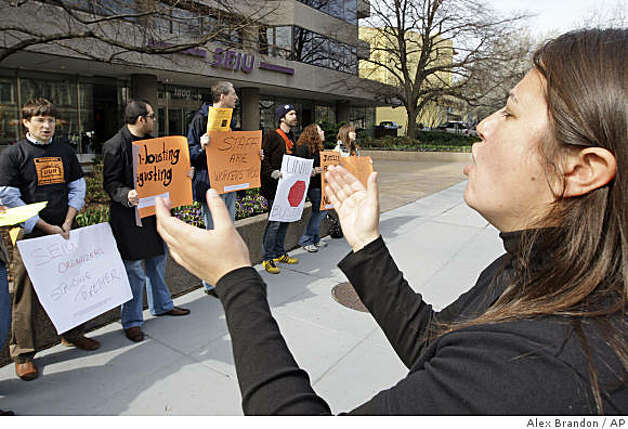
UUR Members Picketing SEIU Headquaters
While there is no shortage of
examples of friction in recent years between staff unions and union
leadership, the most public clashes have been within SEIU. In 2007,
the staff of SEIU Local 1, which is represented by the Teamsters,
went out on strike over low wage levels. There have also been high
profile cases of staff unions openly disagreeing with union
leadership over the direction of the organization. In May, 2008, the
Union of Union Representatives(UUR), which represented around 200
International staff at SEIU passed a unanimous resolution announcing
their opposition to their members being used in the internal conflict
between the leadership of SEIU and SEIU-United Healthcare West. The
resolution stated, “In accordance with our contract, UUR members
should not participate in work that interferes with the ability of
UHW-West members to express their opinions on issues that concern
them.” SEIU leadership subsequently pushed through an amendment at
its convention to reallocate organizing resources to various Locals,
which UUR is barred by its contract from organizing. In early 2009,
SEIU announced it would layoff 75 of the 210 members of the UUR
bargaining unit.
In 2011, after two previous failed attempts, the staff of SEIU/District 1199 WV/KY/OH were able to gain recognition of their staff union. Staff Union 1199 was successful in negotiating their first contract, but less than two years later, management ran a successful campaign to decertify the staff union in late 2013, dismissing some of the pro-union staff members the very day the staff union was decertified. (full disclosure: the author was a charter officer of Staff Union 1199)
Even the oldest staff union in
the United States, UALPAE has had recent friction with management.
In 2011, the NLRB ruled that ALPA committed Unfair Labor Practices
alleged by the staff union when it implemented unilateral changes
before reaching impasse.
Staff Unions are not a phenomenon strictly limited to the United States. According to Derek Blackadder, Regional Director for the Canadian Union of Public Employees(CUPE), staff unions are very common in Canada. Andrew Casey, a LabourStart correspondent based in Australia, informed me that the Australian Services Union represents union staff as well. There are also forms of staff unions in the United Kingdom and India as well, but they seem to follow a system used by the United Steelworkers in which staff are members of the parent union, so that everyone is a card-carrying member.
Progressive
or Regressive?
So
if union staff are indeed workers just as the members they represent
are workers, how do they serve the interests of their members, as
well as their own best interest at the same time? What purpose in the
labor movement as a whole can they serve? Are staff unions a
progressive or regressive force in the labor movement? To gain some
insight into these questions, I reached out to Bill Fletcher,
longtime labor activist and educator, as well as the author of
Solidarity
Divided,
and the recently released
“They're Bankrupting Us!” And 20 Other Myths About Unions.
On the question of the role staff unions can play in the labor
movement, Fletcher responded that they have the ability to be both a
positive and negative force. They can be a positive force by being
“Partners for change, working with elected leaders to help change
the direction of the organization as well as stopping arbitrary
conduct of some leaders.” Fletcher also cautioned that there
exists the possibility to be a negative force by “Freezing ways of
doing work even if it doesn't serve the purpose of the union.”
While there are certainly a variety of positions regarding exactly how staff unions fit into the labor movement, a consistent sentiment expressed by everyone contacted for this article was the necessity of staff unions. Fletcher, who identified himself as a strong supporter of staff unions, expressed the reason staff unions are necessary is that “In any organization that is cause driven, there is a tendency to treat the staff as almost disposable quantities, and it is OK to burn them out in service to the cause.” Since the beginnings of organized labor in the United States, one simple philosophy has united labor organizations of every kind. As I used to hear J. David Cox, President of the American Federation of Government Employees(AFGE) say: “If you've got a boss – you need a union.” It should not matter who the boss is.
If labor unions are to remain the vanguard of the working class, it is imperative that they remain true to the ideals of the labor movement, both in theory, as well as in practice. All members should look at their union and ask, which side are you on?

